Translate

Tuesday, January 25, 2011

OFFICIAL REPORT! MUST READ!

Dog food had the highest result for nine of the 15 toxic elements!

(Thank You Susan @ TruthAboutPetFoods.com)

Commercial pets foods contain a lot more than the advertised choice cuts of meat and fresh vegetables.  Some pet foods contain toxic levels of arsenic, lead, mercury, and even nuclear waste. 

http://digital.findanalytichem.com/nxtbooks/advanstar/spectroscopy0111_v2/index.php#/48

"Toxic Element Exposure for Dogs"
"A 50-lb dog eating 5 cups (500 g) a day of dry food or 1 large can of wet food (375 g) with the maximum contamination would be consuming about:
124 mcg (micrograms) of Arsenic (greater than 20 times Reference Dosage limit)
65 mcg of Cadmium (greater than 2 times Reference Dosage limit)
280 mcg of Mercury (greater than 120 times Reference Dosage limit)
5 mcg of Thallium (greater than 2 times Reference Dosage limit)
430 mcg Uranium (greater than 5 times Reference Dosage limit)
1200 mcg Vanadium (greater than 6 times Reference Dosage limit)"
"The average dry dog food exceed the Reference Dosage levels for many compounds and wet dog food had fewer results exceeding the human Reference Dosage limits."


Spex CertiPrep President Ralph Obernauf (a pet owner who lost his dog questionably early) provided TruthaboutPetFood.com with the abstract of their testing back in October 2010.


In other words...uranium, beryllium, and thorium - are nuclear waste.  Nuclear waste in dog foods and cat foods from budget to premium.  No extra charge.

Monday, January 17, 2011

Cleaning Your Dogs Ears


  1. Use an ear wash formulated for ear cleaning. It's important to never use undiluted peroxide on your pet's ears as it may cause burning.

  2. Soak a cotton ball thoroughly in the ear wash. Squeeze out excess ear wash.

  3. Place the cotton ball in your dog's ear and gently rub up and down.

  4. Allow your dog to shake off excess moisture. This is important for preventing ear infections.

  5. Soak the tip of a cotton swab in the ear wash and run it along the nooks and crannies of your dog's ears.

  6. Avoid putting the swab down your dog's ear canal; leave this type of cleaning to the veterinary medical staff.


Tips & Warnings

  • Never use pure undiluted peroxide on your pets ears. The peroxide can harm your dog!
  • If your dog has chronic ear infections, consult a veterinarian. Chronic ear infections could be a sign of allergies or other problems.
  • If the ear canal looks abnormal, clean only the outside and consult a vet.

Friday, December 10, 2010

HOLIDAY SAFETY TIPS


Mistletoe and Holly
Toxic to Cats and Dogs
Clinical Signs:  Vomiting, diarrhea and depression.

Poinsettia Plant
Toxic to Cats and Dogs
Clinical Signs:  Irritating to the mouth and stomach, sometimes causing vomiting, but generally over-rated in toxicity.

Lilies
Highly toxic to Cats
Clinical Signs:  kidney failure.

Winter Hazards for Pets
Winter brings cooler temperatures, holidays and seasonal hazards. Listed below are a few examples of potentially hazardous items that pets might encounter during this time.

Low Toxicity: (may cause gastrointestinal upset, but unlikely to cause serious problems unless very large amounts are ingested)
•    Christmas tree preservatives (stale water in tree stands can harbor bacteria)
•    Poinsettias
•    Holly
•    Canned "snow"

Moderate toxicity: (may cause significant signs beyond mild gastrointestinal upset)
•    Mistletoe (species-dependent)
•    Ice melting products
•    Liquid potpourri
•    Batteries

High toxicity: (potential for very serious or life-threatening signs)
•    Antifreeze/coolants
•    Chocolate
•    Rising bread dough (yeast produce ethanol, rising dough can produce bloat and foreign body)
•    Sugar substitute xylitol used in homemade baking goods and holiday treats can cause hypoglycemia and liver failure
•    Human medications (cold and flu medications, decongestants)
•    Alcoholic beverages
•    Homemade "play-dough” (high sodium content)

Source:  ASPCA Animal Poison Control Center

Saturday, November 20, 2010

Maximizing Love


Man's Best Friend...Literally!
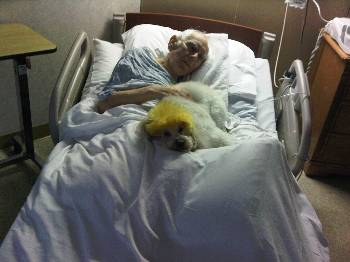
This is Max and his Dad. Max came to Postmore Kennels some time ago because his Dad could no longer care for him. He's been quite ill. But Max never forgot his roots and visits him often.

It is the highlight of his Dad's day to see Max.
There has always been a healing quality between humans and animals and Max is no exception.
These two "old men" have a bond that will carry them to the end.


A familiar photo in homes all over the world.
We are judged in some cultures by how we treat our animals.
We at Postmore Kennels hope this photo will do our judgement justice.

Monday, November 1, 2010

LOVE IS A WONDERFUL THING

Instructions for properly hugging a baby

  First, uh, find a baby..  


Second, be sure that the object you found was indeed a baby by employing classic sniffing techniques.

Next you will need to flatten the baby before actually beginning  the hugging process.


The 'paw slide' Simply slide paws around baby and prepare for possible close-up. 


Finally, if a camera is present, you will need to execute the difficult and patented 'hug, smile, and lean' so as to achieve the best photo quality.


Friday, October 15, 2010

HOW TO REMOVE TICKS

Thanks to INSTRUCTABLES
(it's flea and tick season again!)

I will demonstrate how to easily remove a tick from your dog without pulling it out. The tick will crawl out on it's own and you won't have to deal with 'did I get it all out?'. This sounds like a magic trick and you might even think it is, I did. My sister inlaw had been telling me how to do it for quite a while and I just never tried it, because I didn't think it would work. One day when I was at the vet getting my dogs their yearly shots, my vet found a tick and removed it using this method and I was sold.

I easily remove about 20 ticks a year from my two dogs. When I used the old way, which was get your tweezers as close to the head of the tick and pull straight out, it would often leave parts of the tick behind. Ticks seem to like areas near the eyes and ears, which would leave marks and scars that wouldn't ever go away.

So how do you do it?
Rub the tick in a circular motion and pretend you're trying to make the tick dizzy. I generally stick with one direction, clockwise. It usually takes less than a minute, so if it's not working, make sure the body of the tick is moving around. Remember you can't get dizzy unless you're actually moving in a circle, quickly. I doubt the tick actually gets dizzy, but they sure don't like something about the movement and they crawl out on their own.

Monday, October 11, 2010

FOOD IS MOST IMPORTANT TO PET HEALTH

REPOST
 (Thanks Susan! You're our Hero!)


Many of us have worked for years trying to bring awareness of health/illness reports of pets directly linked to pet food.  For what seems to be forever, only other concerned pet owners have listened. However, things are changing.  Our efforts are beginning to show results.

An example of our efforts showing results...the recent Blue Buffalo dog food recall.  Not the recall itself, but how it happened.  Here's how I see pet owner efforts have led to this shift...

While Big Pet Food dismisses pet related blogs, often telling pet owners these websites are the foundation of misinformation, pet blogs/websites have helped save lives when it comes to a tainted pet food.  Countless thousands of pet owners have closely followed numerous pet websites, learned from these websites and shared with fellow pet owners for years.  Pet food information learned from these websites has altered pet food choices.  Informed/educated pet owners have then visited their veterinarians questioning quality of nutrition and common pet food ingredients.

At first, veterinarians were caught off guard.  By-products?  What?  BHA/BHT, ethoxyquin?  What?  What food was recalled?  “In the past I have been caught with my clients notifying me of recalls, which sort of makes you look like an idiot in the client’s eyes,” writes Dr. Randy Davis of Evansville, Ind., in a VIN discussion. “What — you're the vet and don't know about this?”  http://news.vin.com/VINNews.aspx?articleId=16618

To provide veterinarians with the latest online news, VinNews supplied forums for vets to discuss various health issues and learn from each other.  In September, VinNews announced a recall notification system for vets.  And then something amazing happened...

Statements from veterinarians linking a pet illness/death to pet food have been few and far between.  While perhaps vets thought or discussed in private a possible link to a tainted pet food, public statements were rarely made.  Then, in late August 2010, VinNews.com provided public news about pet illness linked to Blue Buffalo dog food.  And in early October 2010, Michigan State University did the same; publically announcing a link to illness in dogs and Blue Buffalo dog food.


Within hours after Michigan State University Diagnostic Center posted their information on the Internet, 10/8/2010, Blue Buffalo recalled various brands of dog foods.

I don't believe the timing was coincidence.  Two public statements from veterinarian organizations firmly suspecting a link between pet illness and a pet food would be a difficult thing for any pet food to ignore.  While pet owner complaints can/have gone ignored for years by (most) pet food, veterinary complaints are much more challenging to dismiss.

I cannot say thank you enough to VinNews and MSU.  Both of you have taken a brave step forward; both of your actions is a step to improved trust between pet owners and their vets.  Thank you, thank you, thank you.  


Pet Owners...take a moment to pat yourself on the back as well.  We have nudged this momentum forward.  Our determination to learn the 'truth about pet food' (and I don't mean just from this website - all sources of pet information) and our determination to share what we've learned has shifted the 'don't tell' foundation pet food has had on everyone in the past.  http://www.truthaboutpetfood.com/articles/a-shift-in-pet-food-incident-awareness.html